Why All-in-One Software Tools Are Bleeding Your Business Dry
Oct 3, 2025

Small business owners are being sold a lie. And it's costing them thousands.
The promise sounds too good to be true: one platform, every feature you need, seamless integration, lower costs. But behind the glossy marketing of all-in-one software tools lies a harsh reality that's quietly draining businesses of money, efficiency, and competitive edge.
Research reveals that 70% of companies using all-in-one platforms report compromised functionality, yet they continue paying premium prices for subpar performance. Even more concerning? Enterprise software switching costs average 25-30% of IT budgets, creating a financial prison that keeps businesses trapped in underperforming solutions.[^1][^2]
It's time to expose the all-in-one software scam for what it really is: a carefully orchestrated vendor lock-in strategy designed to maximize profits while minimizing your options.
The Jack-of-All-Trades Fallacy
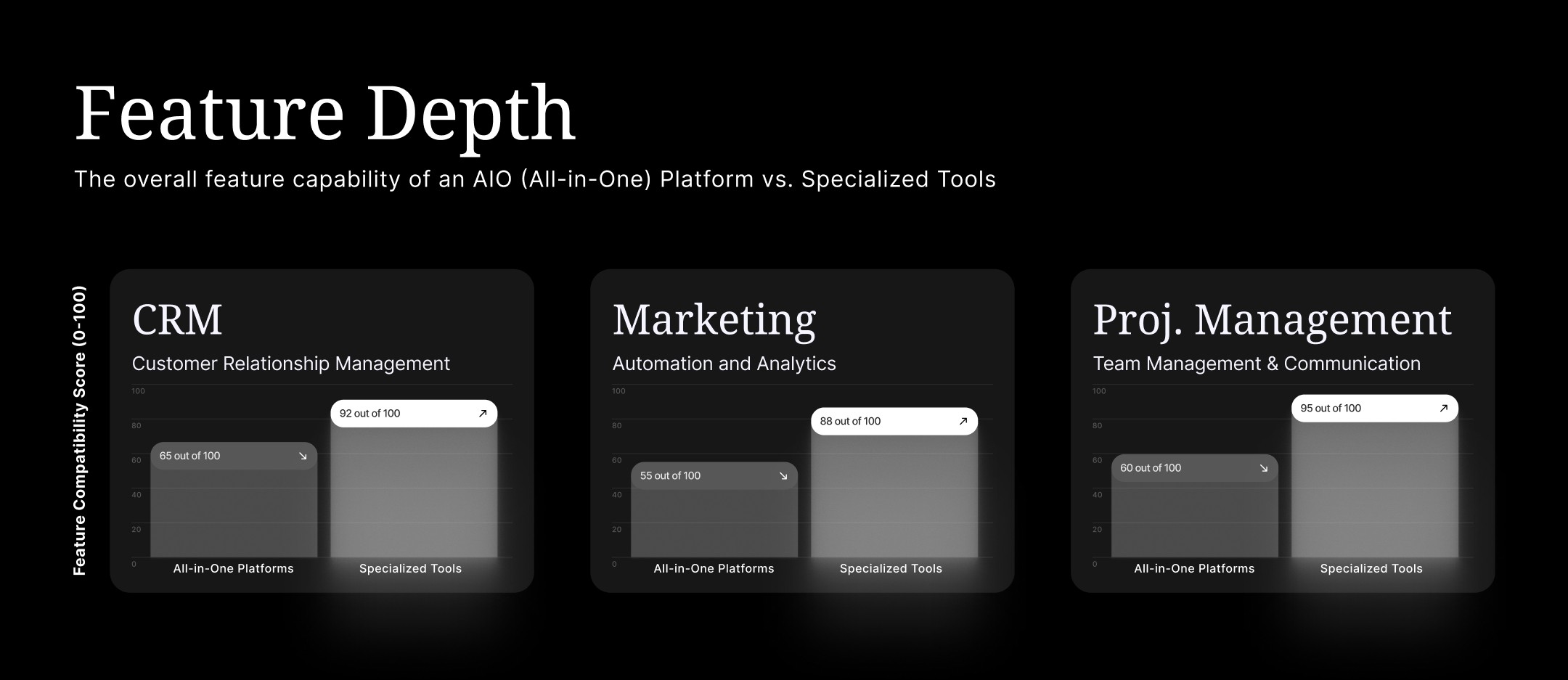
All-in-one platforms operate on a fundamentally flawed premise: that breadth can substitute for depth. The saying "jack of all trades, master of none" isn't just a quip—it's a mathematical inevitability when development resources are spread across dozens of features instead of concentrated on excelling at a few.
Consider HubSpot, often hailed as the gold standard of all-in-one marketing platforms. While it offers CRM, email marketing, landing pages, and analytics under one roof, users consistently report frustrations with feature limitations. One business owner noted that essential features like conditional logic for forms and quote customization require expensive upgrades, with pricing jumps of over 7,000% from starter to professional tiers.[^3]
The numbers tell the story. Best-of-breed tools typically outperform all-in-one platforms by 20-30% in their core competencies. When Salesforce users were surveyed about platform limitations, the most common complaints were slow reporting capabilities, unintuitive interfaces, and lack of native tools that forced reliance on expensive third-party integrations.[^4][^5][^6]
This isn't coincidental—it's by design. All-in-one platforms invest their development resources horizontally across many mediocre features rather than vertically into exceptional ones. The result? You're paying premium prices for software that does everything poorly instead of anything exceptionally well.
The True Cost of "Convenience"

The pricing game that all-in-one platforms play is masterfully deceptive. They hook you with attractive entry-level pricing, then systematically increase costs through tier upgrades, feature gates, and vendor lock-in strategies.
Take the real-world example highlighted by Nutshell CRM: a three-year HubSpot implementation costs $270,748 compared to $58,710 for their specialized alternative. That's a difference of over $212,000—money that could be reinvested in growth, hiring, or actual business improvements.[^7]
The hidden costs extend far beyond licensing fees:
Implementation and Integration Costs
API integrations for all-in-one platforms range from $50,000 to $150,000 annually, with enterprise integrations often requiring 6-18 months for full deployment. Meanwhile, specialized tools can be implemented in weeks with integration costs starting as low as $2,000 for basic connections.[^8][^9][^10]
Training and Adoption Expenses
All-in-one platforms require comprehensive training across multiple modules, with **63% of companies reporting implementation difficulties**. Each additional feature set means more time away from revenue-generating activities, with training costs that compound as employee turnover occurs.[^6]
Opportunity Costs
Perhaps most damaging are the invisible opportunity costs. When your CRM takes 45 seconds to generate a report that a specialized tool could produce in 5 seconds, that's 40 seconds multiplied by every report, every day, every employee. **Studies show employees lose an average of 23 minutes of productivity after each context switch**—and all-in-one platforms are context-switching factories.[^11]
The Vendor Lock-In Trap
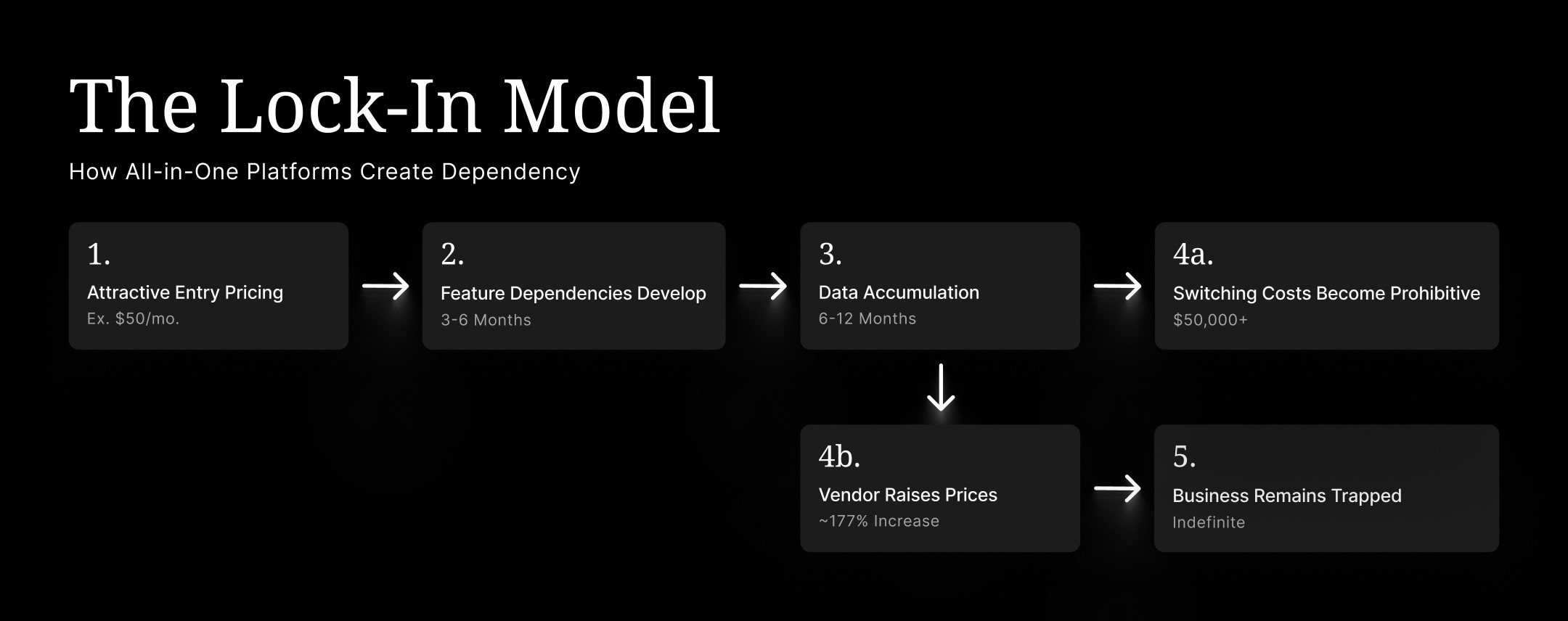
Vendor lock-in isn't an accident—it's the entire business model. All-in-one platforms are designed to create dependency through what economists call "switching costs." Once you're trapped, they have pricing power.
The lock-in mechanisms are sophisticated:
Data Accumulation Strategy
Platforms encourage you to store increasing amounts of data in their systems, making migration exponentially more complex and costly. 47% of enterprises cite data migration as a significant barrier to switching providers, with migration costs often exceeding $100,000 for enterprise implementations.[^12][^13]
Proprietary Integration Dependencies
All-in-one platforms create webs of internal dependencies. Salesforce users with 10+ integrations have 40% lower churn rates—not because they're satisfied, but because switching becomes financially devastating.[^1]
Contract and Pricing Manipulation
Microsoft's recent Dynamics 365 price increases of up to 177% demonstrate how vendors exploit lock-in. Once you're dependent on their ecosystem, they can essentially hold your business hostage to extract higher profits.[^14]
The most insidious aspect? The longer you stay, the more trapped you become. Every additional feature you adopt, every integration you build, every workflow you customize adds to your switching costs. It's a financial maze designed with no exit.
Real-World Casualties: When All-in-One Goes Wrong
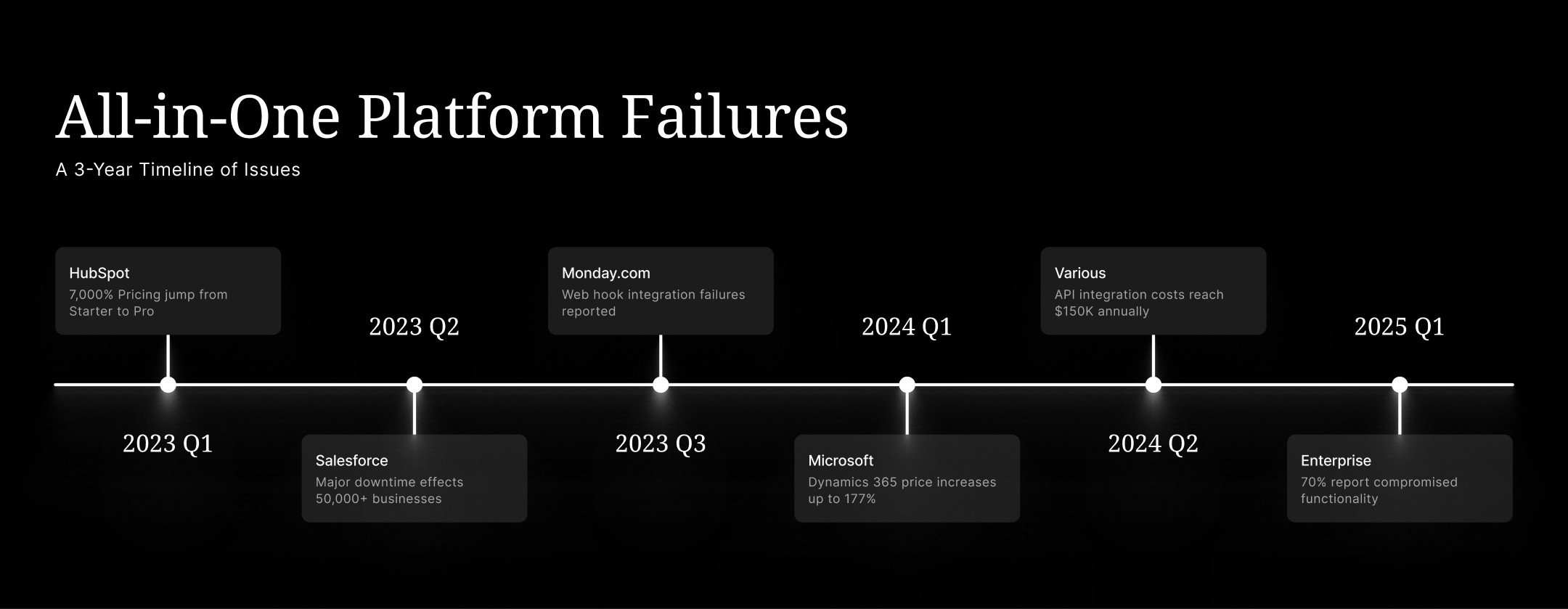
The theoretical problems with all-in-one platforms become stark reality when examining actual business impacts:
Monday.com Integration Nightmares
Users consistently report webhook integration failures, with solutions requiring complete system rebuilds and extensive troubleshooting. For businesses relying on automated workflows, these failures can mean missed opportunities and broken customer experiences.[^15][^16]
HubSpot's Feature Gatekeeping
Basic functionality like quote customization and conditional form logic—features that specialized tools include as standard—require expensive tier upgrades in HubSpot. Small businesses find themselves paying enterprise prices for basic functionality.[^3]
Salesforce Complexity Overload
Despite its market dominance, enterprises frequently seek Salesforce alternatives due to complexity, slow performance, and limited integrations. The platform's broad feature set creates such complexity that companies need dedicated administrators and expensive consultants just to maintain basic functionality.[^4]
These aren't edge cases—they're predictable outcomes when platforms prioritize feature quantity over quality.
The Economics of Specialization
**[Visual Placeholder: ROI comparison chart showing 3-year performance metrics - X-axis: Business metrics (Implementation Speed, Feature Satisfaction, Integration Success Rate, Total Cost, User Productivity), Y-axis: Performance scores (0-100), comparing all-in-one vs. best-of-breed approaches.]**
The economic argument for specialized tools becomes compelling when you examine total cost of ownership and productivity metrics:
Implementation Speed
Best-of-breed solutions can be deployed in weeks versus 6-18 months for comprehensive all-in-one platforms. Faster implementation means faster time-to-value and reduced opportunity costs.[^17][^10]
Integration Efficiency
While all-in-one platforms promise seamless integration, reality differs. 39% of best-of-breed users spend over 20% of IT budgets on integration versus 29% of suite users—but they're integrating superior tools that deliver better outcomes.[^18]
True Productivity Gains
Specialized tools excel in their domains. Email marketing platforms deliver higher engagement rates, dedicated CRMs provide faster data access, and purpose-built analytics tools offer deeper insights. The productivity gains from using best-in-class tools often outweigh integration complexity.
Cost Predictability
Specialized tools typically offer more transparent, predictable pricing. You pay for what you need without subsidizing mediocre features you don't use.
Breaking Free: The Path Forward
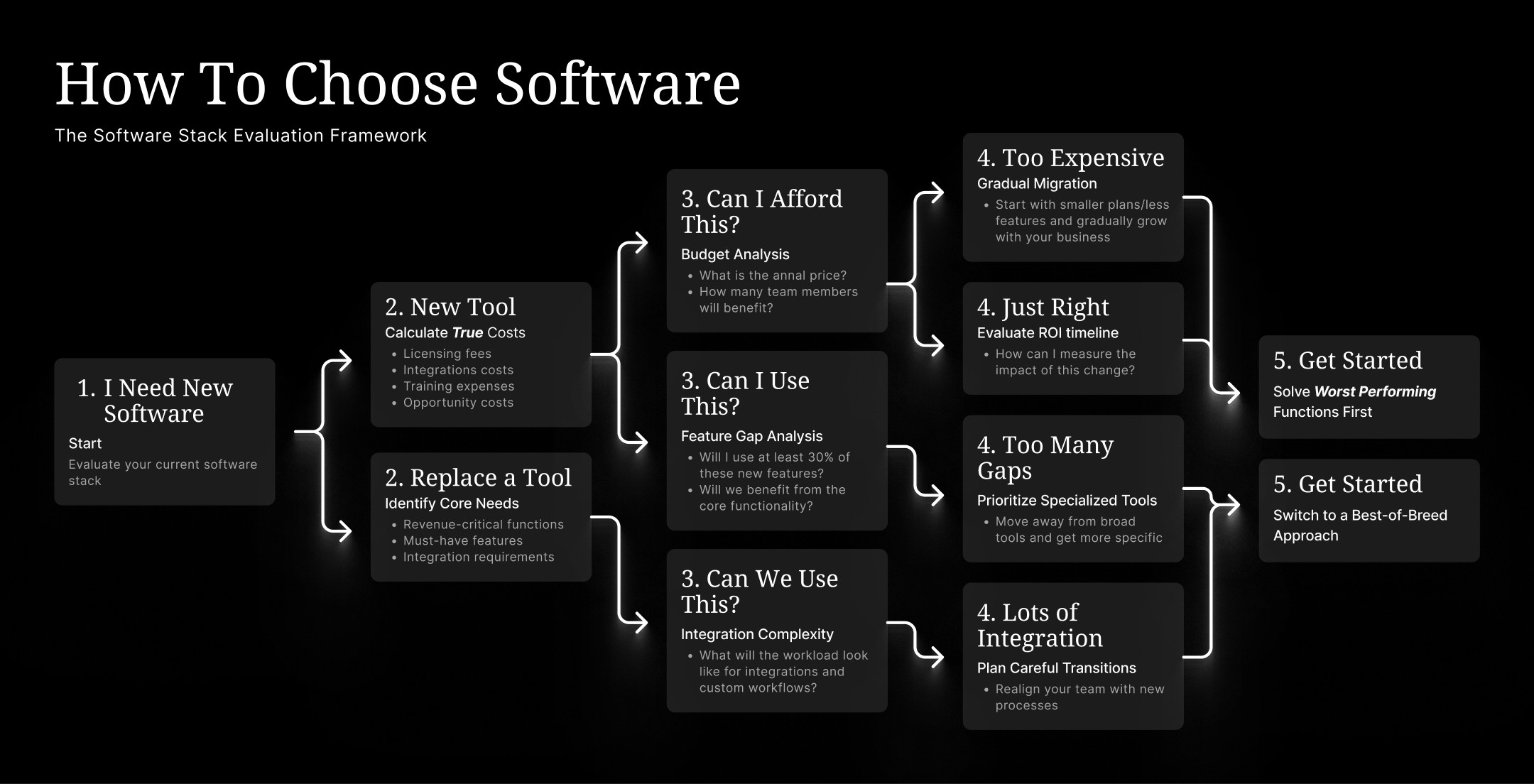
Escaping the all-in-one trap requires strategic planning and honest assessment:
Audit Your Current Costs
Calculate the true cost of your current all-in-one platform, including licensing, integration, training, and opportunity costs. Many businesses discover they're spending 2-3x what they initially budgeted.
Identify Core Needs
Most businesses use only 20-30% of an all-in-one platform's features. Focus on the 3-5 core functions that directly impact revenue and customer satisfaction.
Evaluate Switching Costs
While switching costs are real, they're often lower than vendors want you to believe. Cloud migration projects average $1.2 million and 8 months for enterprise organizations, but small businesses can often migrate specialized tools for a fraction of that cost.[^12]
Plan Gradual Transitions
You don't need to switch everything at once. Start with the area where your all-in-one platform performs worst, implement a specialized solution, and gradually migrate other functions as contracts come up for renewal.
The Strategic Advantage of Purpose-Built Tools
Companies using best-of-breed approaches aren't just saving money—they're gaining competitive advantages:
Innovation Speed
Specialized vendors innovate faster in their domains than all-in-one platforms can across their entire feature sets. You get access to cutting-edge capabilities months or years before they appear in integrated suites.
Scalability
Best-of-breed tools scale more efficiently. As your business grows, you can upgrade individual components without overpaying for unused features across an entire platform.
Risk Mitigation
Diversifying your software stack reduces single-vendor risk. If one tool experiences downtime or discontinuation, your entire operation doesn't collapse.
Negotiating Power
Multiple vendor relationships create competition for your business, leading to better pricing and service levels than single-vendor dependency allows.
The Bottom Line: Your Business Deserves Better
The all-in-one software industry has built a profitable empire on a simple premise: convenience trumps capability. But in an era where competitive advantages are measured in minutes and margins, "good enough" isn't good enough anymore.
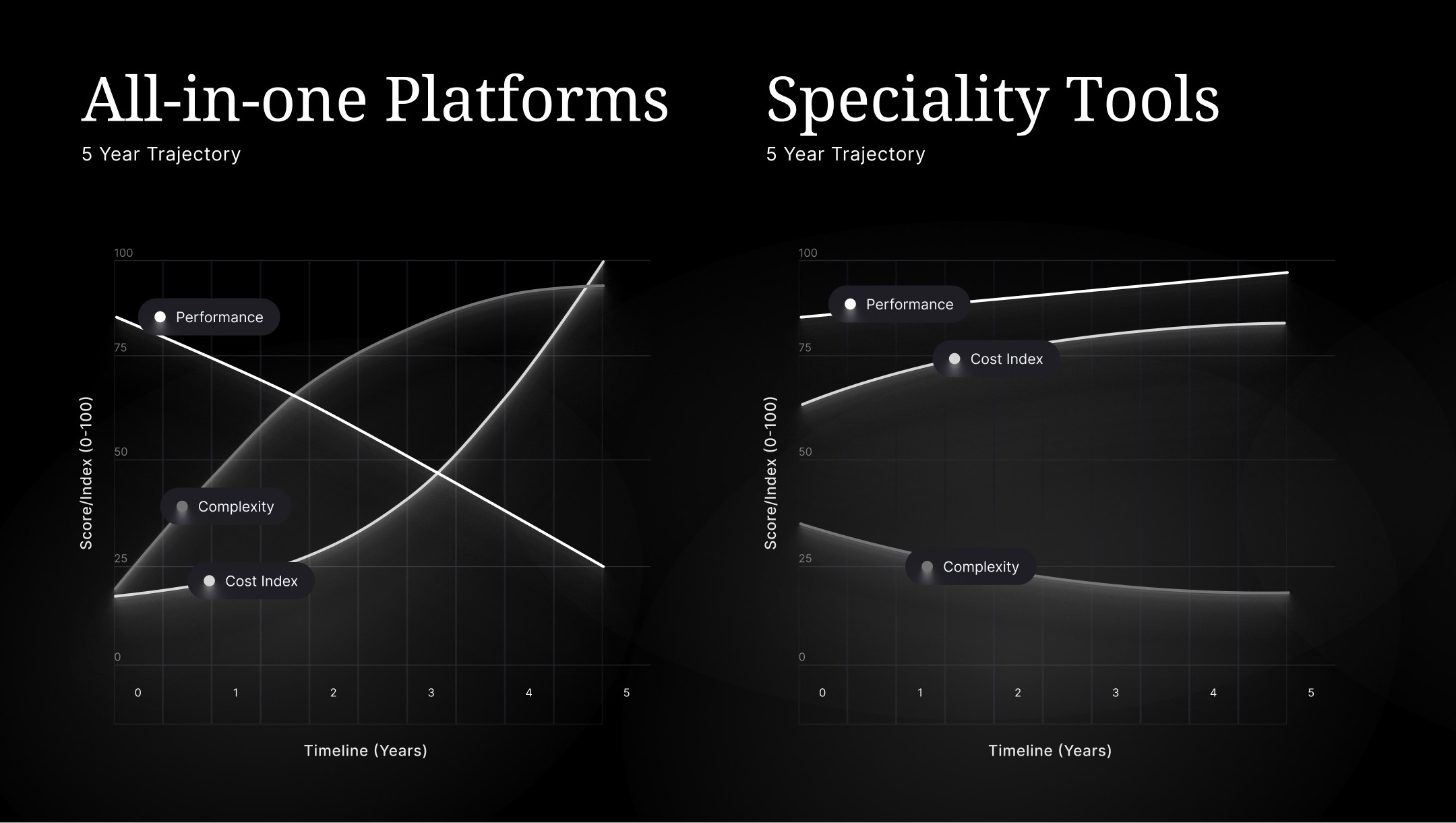
Your business doesn't need software that does everything—it needs software that excels at the things that matter most to your success. The companies thriving in today's market aren't the ones with the most features; they're the ones with the best tools for their specific needs.
The choice is yours: continue subsidizing mediocrity wrapped in marketing promises, or invest in specialized tools that actually deliver results. Your bottom line will thank you for choosing capability over convenience.
The software evaluation landscape is more complex than ever, with new platforms launching daily and existing providers constantly evolving their offerings. Making informed decisions requires deep analysis, comprehensive comparisons, and insider knowledge of how these tools perform in real-world scenarios.
Ready to cut through the marketing noise and discover the software solutions that will actually move your business forward? Join our email list for early access to our comprehensive software comparison platform—where we evaluate tools based on performance, not promises. Get notified when we launch detailed analyses that could save your business thousands while boosting productivity.